Blog
15 Apr 2026
Ballistic Briefcase: Discreet Protection for Unpredictable Situations
At first glance, ballistic briefcases look like classic business bags. Inside, however, they contain certified soft ballistic protection that can be deployed within seconds to create a mobile, maximised protective surface in an emergency.
This blog post provides an overview of how ballistic briefcases are generally constructed, who they may be relevant for, and which performance characteristics matter when selecting a product.
Intended use and target groups
A ballistic briefcase combines two functions:
- Transport of documents, laptop and work materials
- An integrated soft ballistic panel that can protect against handgun ammunition
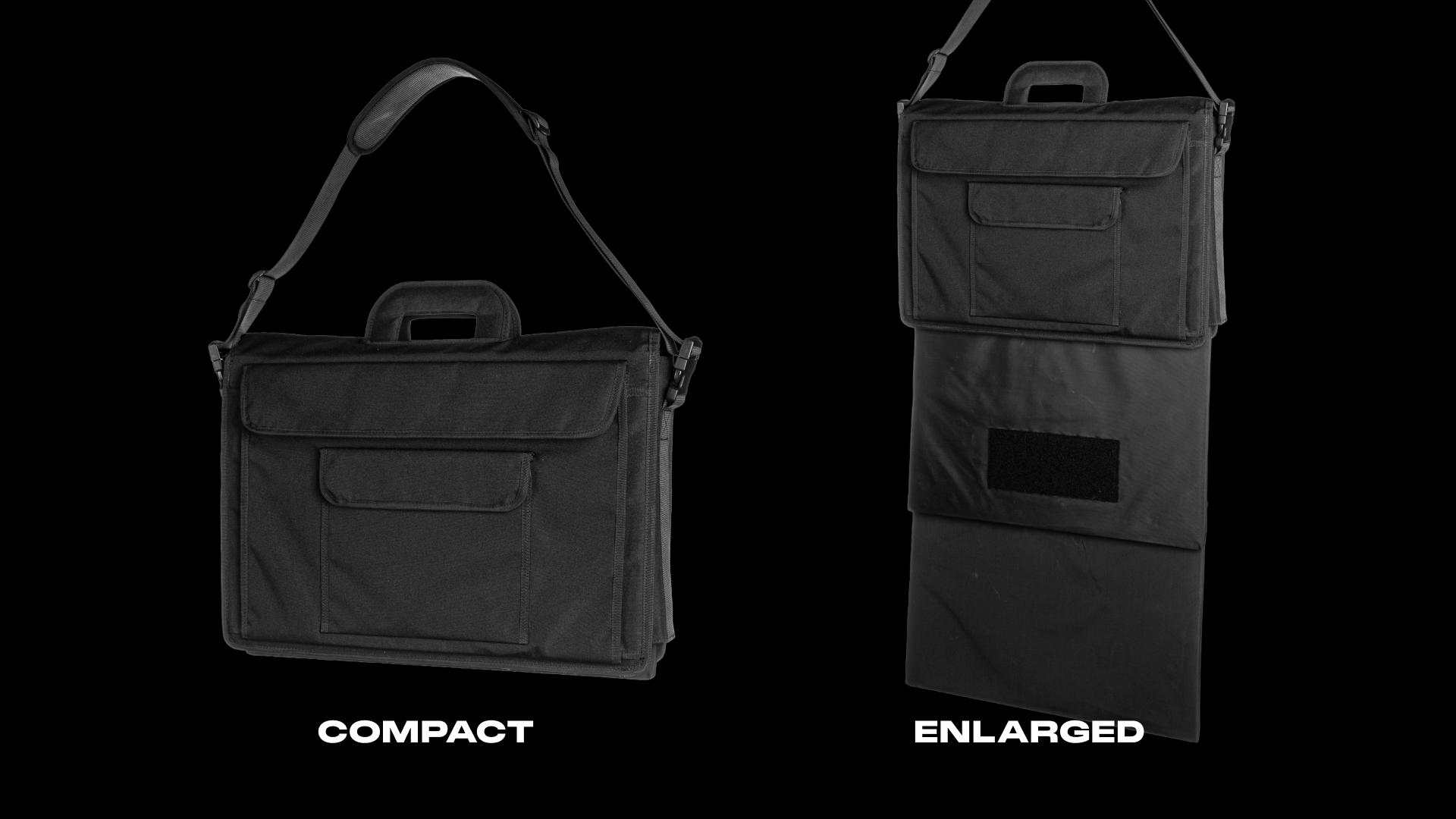
In everyday use, the bag is carried like a normal briefcase and is visually unobtrusive. Only in a threat situation is it deliberately positioned or unfolded so that the largest possible protective surface is placed between the carrier and the attacker. Some models can be opened or “dropped” with a simple movement so that the protective modules automatically transform into a larger surface.
Typical fields of use:
- Close protection and escort services
- Public authorities and organisations with security tasks
- Security staff in lobby, reception or access areas
- Individuals with an increased risk profile in their professional environment
Important: A ballistic briefcase does not replace comprehensive protective equipment; it complements it, particularly for transitions and travel routes.
Protection levels and ballistic performance
Manufacturers of ballistic briefcases generally follow established standards. Commonly encountered are:
- Protection levels in the range of NIJ Level IIIA (e.g. according to NIJ 0101.04 or NIJ 0108.01)
- Protection classes under German or European guidelines that broadly correspond to comparable handgun protection levels
- Tests based on VPAM standards or technical directives for ballistic protective equipment
In general, such bags are designed to stop common handgun ammunition – typically including certain 9 mm threats – within the defined test framework. In addition, v50 tests in accordance with STANAG 2920 using fragment-simulating projectiles are often carried out to assess fragment protection. The exact values vary depending on product and material construction.
Key factors when selecting a product:
- Reliable test reports from an accredited test laboratory
- Clear specifications of the protection level
- Transparency regarding which types of ammunition and which scenarios the briefcase has been tested against
Design, mechanics and protective surface
Ballistic briefcases are intended to be both discreet and functional. Typical features of many models include:
Discreet appearance
A look similar to a classic black or dark business or laptop bag.
Deployment mechanism
With a simple movement (e.g. letting go of a carrying handle or releasing a fastener) a larger ballistic surface is deployed.
In its compact state, the protective modules are stacked or folded; when opened, they form an elongated, significantly enlarged protective surface.
Expandable protective surface
Depending on manufacturer and model, the protective dimensions range from approximately “standard briefcase format” to a clearly larger surface – typically sufficient to cover the upper body and parts of the lower body when the bag is held in front of the torso.
Protection of materials
The ballistic inserts are usually enclosed in robust covers (e.g. polyamide fabric) to protect them from moisture, dirt and mechanical stress in everyday use.
Thanks to this combination, the bag remains discreet in daily life and is only recognisable as protective equipment when deployed in an emergency.
Carrying comfort and everyday usability
To ensure ballistic briefcases are actually used, they must prove themselves in day-to-day working life. Relevant aspects include:
Weight
Depending on design and size, ballistic briefcases weigh several kilograms. This is noticeable, but should still allow for extended carrying times.
Handles and ergonomics
Many manufacturers use reinforced, sometimes rubberised handles or padded carrying elements to improve comfort and provide a secure grip – for both right- and left-handed users.
Storage space
Real added value is created when the bag not only offers protection, but also serves as a fully functional work or document bag: compartments for files, notebooks, tablets and accessories are therefore standard in many models.
Unobtrusive colour
Classic colours such as black or dark grey support the discreet appearance and fit into formal environments such as offices, conference centres or public authorities.
Everyday usability
The better carrying comfort and functionality are addressed, the more likely it is that the bag will be consistently carried in everyday life – and thus actually be available in an emergency.
What Users Should Consider When Selecting a Product
Anyone considering the use of a ballistic briefcase should look at several aspects:
Define protection requirements
- Which threat scenarios are realistic?
- Are handguns the main concern, or are additional risks (e.g. fragments, knives) also considered?
Check standards and test reports
- Do the specified protection levels comply with recognised standards (e.g. NIJ, VPAM, national standards)?
- Is there documentation from independent laboratories?
Size and protective surface
- Does the deployed protective surface sufficiently cover the relevant body area?
- Does the size and shape suit the person (height, preferred carry position)?
Weight and ergonomics
- Is the weight acceptable for daily use?
- Can the bag and protective surface be brought into position quickly and intuitively under stress?
Summary
Ballistic briefcases are a specialised niche product at the interface between business equipment and personal protective gear. They provide the option of discreetly carrying an additional layer of protection in a professional environment without compromising the appearance of a classic briefcase.
Modern models combine soft ballistic inserts at handgun protection level with deployable protective surfaces, ergonomic carrying elements and fully functional storage space for everyday work. It is crucial that users understand their own requirements and critically review protection levels and test reports.
Images and graphics
Mehler Protection, Mehler Vario System GmbH (All rights reserved, 2026)